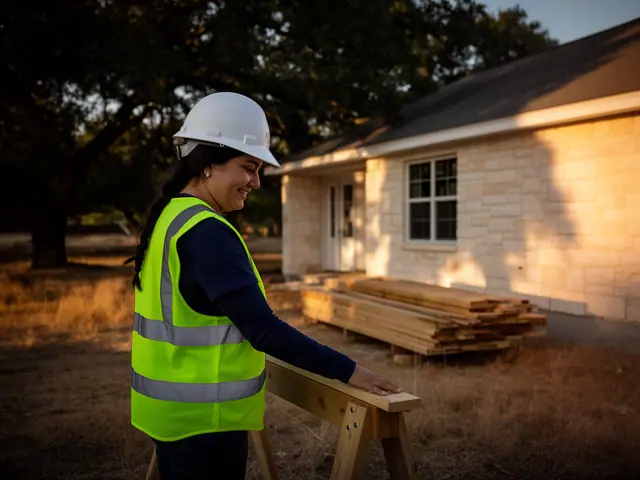
Seguin, TX home builders and HVAC contractors cover materials before a draw pays with a revolving business line of credit drawn for each stage and repaid when the draw lands, supplier terms at the lumber yard and supply house, and sometimes a short working capital loan for payroll. A line fits because the gap repeats with every house.
This article from Truegrove Funding Group in Seguin, Texas explains why construction draws and retainage leave builders and mechanical contractors short on cash, how a line of credit and working capital fill the gap, and what lenders read, with Guadalupe County figures and an invented draw schedule.
Why draws and retainage leave Guadalupe County, TX builders short on cash
A construction draw pays for work already done. The builder pays the slab sub, the framing crew and the lumber yard, then asks the construction lender for the draw; the lender sends an inspector, approves the stage and releases the money. Days or weeks pass between the builder's payments and the draw, and an inspection that finds a punch-list item can add more.
Retainage widens the gap on commercial and some residential work: the owner holds back part of each payment until the project is finished. A subcontractor can finish its scope early and still wait months for the last slice.
Construction counted 391 employer establishments in Guadalupe County, TX in 2023, more than any other sector, including 66 residential building contractors (County Business Patterns). The county recorded 1,697 new housing units authorized by building permits in 2025 (Building Permits Survey).
A credit line for materials vs a working capital loan for payroll
A business line of credit fits materials: draw for each stage, repay when the draw lands, draw again for the next. Interest runs only while money is out. A working capital loan fits a one-time payroll gap with a known end, such as carrying a crew through a long inspection delay on one large job.
A builder with several houses at different stages may hold a line large enough for the biggest overlap of unpaid stages. A builder with one large commercial job and retainage may need a working capital loan sized to the retainage outstanding.
Supplier terms come first: an account at the lumber yard or the supply house can carry materials until the account comes due, leaving the line for what suppliers will not carry.
HVAC contractors carrying parts and van costs until a job closes
An HVAC contractor on new homes buys condensers, air handlers, duct and line sets, installs rough-in and trim-out in two trips, and bills the builder after each phase or at the end. The contractor also pays van payments, fuel and technician payroll every week, while the builder pays on its own schedule after its draw.
Plumbing, heating and air-conditioning contractors counted 76 employer establishments in Guadalupe County, TX in 2023, with $69.2 million in annual payroll (CBP). A line drawn for equipment and payroll, and repaid as builders pay, is one tool; inventory financing for condenser stock is another.
The plumbing and HVAC page covers vans and equipment.
What a lender wants to see from a contractor with slow-paying jobs
A lender reviewing a contractor with slow-paying jobs wants to see that the money does come in, just late. The useful documents are a receivables aging report by customer, a list of jobs with draw or billing schedules, bank statements showing draws and repayments, and the last two or three years of returns.
A work-in-progress schedule, showing each job's contract value, billed to date, cost to date and retainage held, tells a lender more than any single statement. Lenders also ask about the builders or general contractors a sub works for and how reliably they have paid.
A contractor that has kept a line in good standing, drawn and repaid repeatedly, has a record the next partner can read.
An invented draw schedule for a Seguin, TX custom home
Illustration only, invented figures: a Seguin, TX builder uses a line at an invented annual rate of 11.5% for four stages of a custom home, repaying each draw when the construction lender releases it. The days and interest below are invented (our arithmetic).
| Stage | Paid out before the draw | Days until the draw | Interest |
|---|---|---|---|
| Foundation | $32,000 | 18 | $181 |
| Framing | $41,000 | 24 | $310 |
| Rough-in | $28,000 | 16 | $141 |
| Drywall and trim | $35,000 | 21 | $232 |
| Total | $136,000 | $864 |
In this invented schedule, the largest single draw on the line is $41,000, so a limit near that figure, plus room for a second house overlapping, would carry the builder. Total invented interest for the house is about $864, before any line fees.
A draw-gap checklist for Seguin, TX builders and mechanical contractors
- A list of houses or jobs under way, with each draw or billing schedule.
- A receivables aging report and the retainage held on each job.
- Supplier account terms at the lumber yard and the supply house.
- Bank statements showing past draws and how quickly they posted.
- The construction lender or general contractor for each job.
- Existing truck, equipment and line balances.
Financing for contractors has more Guadalupe County figures, and the web form starts a request.
By Truegrove Funding Group · Updated